Logs and analysis
Introduction to logs and analysis
main administratormenu Analysis
In menu Analysis, the following items are available:
- Security checks - check if end users only have access to the data they are allowed to see. See Security checks.
- Session log - an overview of all sessions for all users. See Session log.
- Application claims - an overview of which users have claimed which applications. See Application claims.
- Slow query log - overview of underperforming queries. See Slow query log.
- Session analysis - a pivot table to analyze all user sessions. See Session analysis.
- Two-factor log - an overview of the use of two-factor authentication for all users. See Two-factor log.
- Action analysis - a pivot table to analyze all actions.
- Recommendations - user preference suggestions based on the user logs. See Analyze user behavior and apply recommendations.
- Scheduled system flows - to check the status of the scheduled system flows for your applications. see System flows.
- Notifications - push notifications to users. See User notifications.
More logs are available in the menu Authorization > Applications > Environment monitoring. For more information, see Environment interaction logs.
Slow query log
Performance issues that are not detected during development may arise in a production environment. This is often due to larger datasets or more active users when the application is live. The slow query log identifies underperforming queries, depending on the Query threshold. It logs the following information:
- Date time (UTC) of execution
- Application alias
- Database
- Object
- Server name
- Duration (ms) of execution
- Dismissed (yes/no)
- Reason for dismissal (if applicable)
Enable or disable the slow query log
main administratorThe Slow query log helps you identify underperforming queries, depending on the Query threshold.
To enable the slow query log:
menu Settings > Global settings > tab Form > tab Global settings > group Logging
- Select the checkbox Enable slow query log.
Manage application log retention
To limit the size of the log, only the first 500 bytes or characters of BLOB and CLOB values are stored. The retention period for slow query log data is determined by the Application log retention setting. For more information about logging data and the retention period, see Application log retention.
Include data in the slow query log
main administratorYou can determine whether the Slow query log includes data values in its log entries. This allows you to control whether potentially sensitive data is included in the log and saved in the IAM database.
Only include data in slow query log entries when it is required to troubleshoot a specific issue and when your IAM database is properly secured. For most cases, it is best practice to log without including data values to prevent potentially sensitive information from being stored in the log.
When data values are excluded, the database statement structure remains unchanged, but the actual values are replaced with ?.
For example, filter values, inserted record values, and task parameter values are all logged as ?.
If needed, you can replace the placeholders with actual values during troubleshooting.
To include data values in the slow query log:
menu Settings > Global settings > tab Form > tab Global settings > group Logging
- Select the checkbox Include data in slow query log to include data values.
The Database Event Log in the Debug Center is not affected by this change. It continues to show data values, as it is only visible to the current user for their own session and is not backed by persistent storage.
View the slow query log
To open the slow query log:
menu Analysis > Slow query log
or
menu Authorization > Applications > tab Environment monitoring > tab Slow query log
In this screen, you can:
- Filter queries using Search.
- View logs older than 7 days by deselecting the prefilter Past week.
- Dismiss queries by executing the task Dismiss query
 .
See Dismiss a query.
.
See Dismiss a query. - Universal UI Copy the query text by selecting Copy to clipboard.
- View dismissed queries by deselecting the prefilter Hide dismissed queries or viewing the table Dismissed query objects.
- Remove or edit dismissed queries from the table Dismissed query objects by using the CRUD buttons.
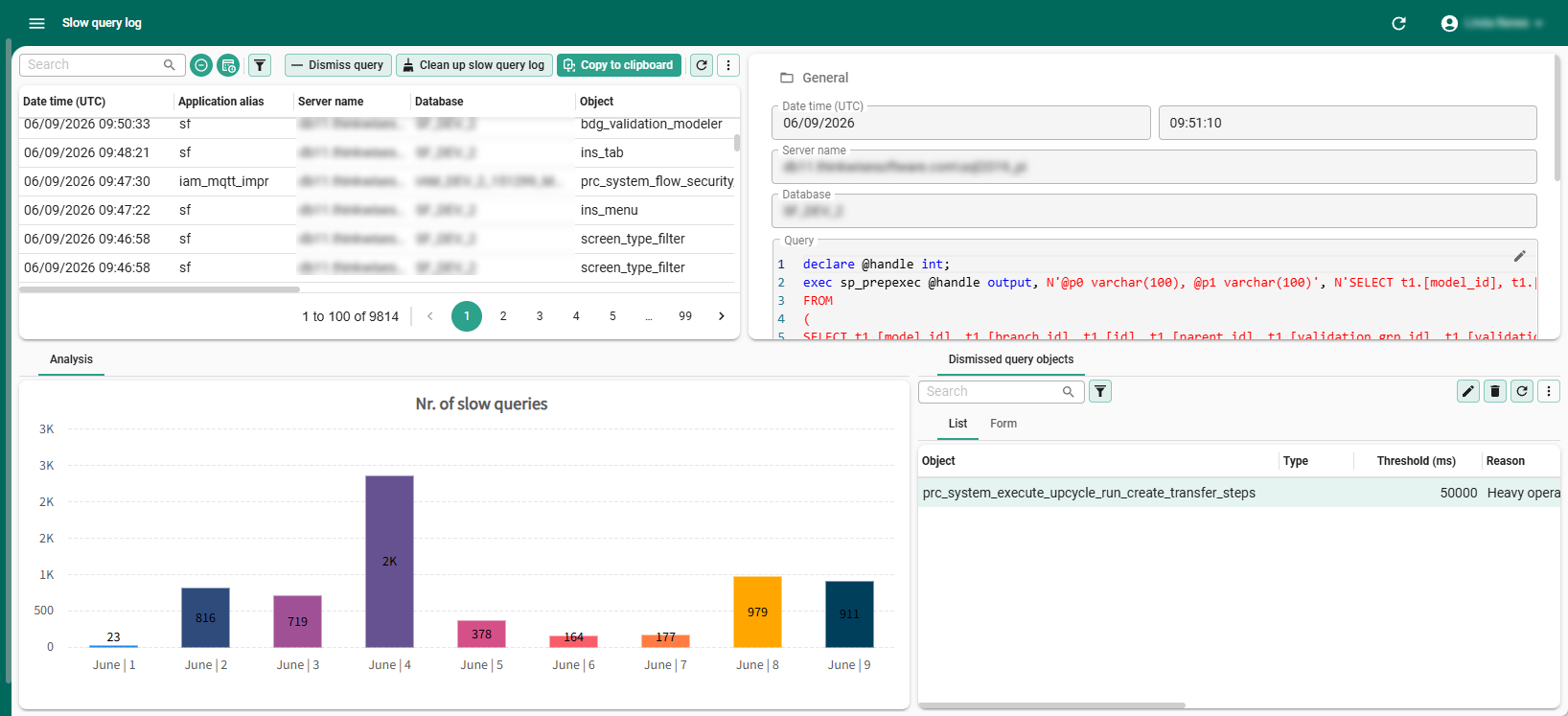 Use the slow query log to identify underperforming queries
Dismiss a query
When using the Slow query log, you can dismiss queries that are known to perform poorly and do not require further investigation.
To dismiss a query:
menu Analysis > Slow query log
or
menu Authorization > Applications > tab Environment monitoring > tab Slow query log
- Select the query you want to dismiss in the grid.
- Execute the task Dismiss query .
- In the pop-up, configure the dismissal options:
- Set a custom threshold - Enter a Custom threshold (ms) for the query. When a future instance of the query falls below the custom threshold, it is automatically dismissed.
- All instances - Dismiss all current and future instances of the query.
- This instance - Dismiss only the instance of the query.
- Dismiss all types - Dismiss statements by their type within an object.
For example, you can dismiss all
INSERTstatements for a specific table, but keepQUERYstatement for that table visible in the log. You can use this setting to dismiss statements that are known to perform heavy calculations to reduce noise in the log. - Dismissal reason - Optional. Enter a reason for dismissing the query.
- Select Execute. Dismissed queries are added to the table Dismissed query objects.
You can adjust the default Query threshold in the menu Settings > Global settings > tab Form > group Logging.
- The default is 200 ms.
- Do not set the Query threshold too low, as this can impact performance and cause the log to grow excessively. See Application log retention for more information.
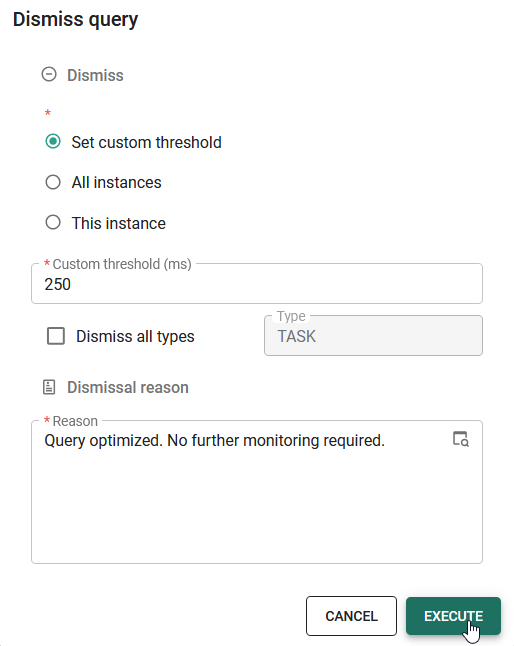 Dismiss a query